
Pre-Printed Badge Stock vs Blank Inserts for Large Conferences
Pre-printed stock improves branding consistency and can reduce event-day work. Blank inserts are flexible and easy to update. The right choice depends on registration volatility, materials, deadline risk and the equipment available.
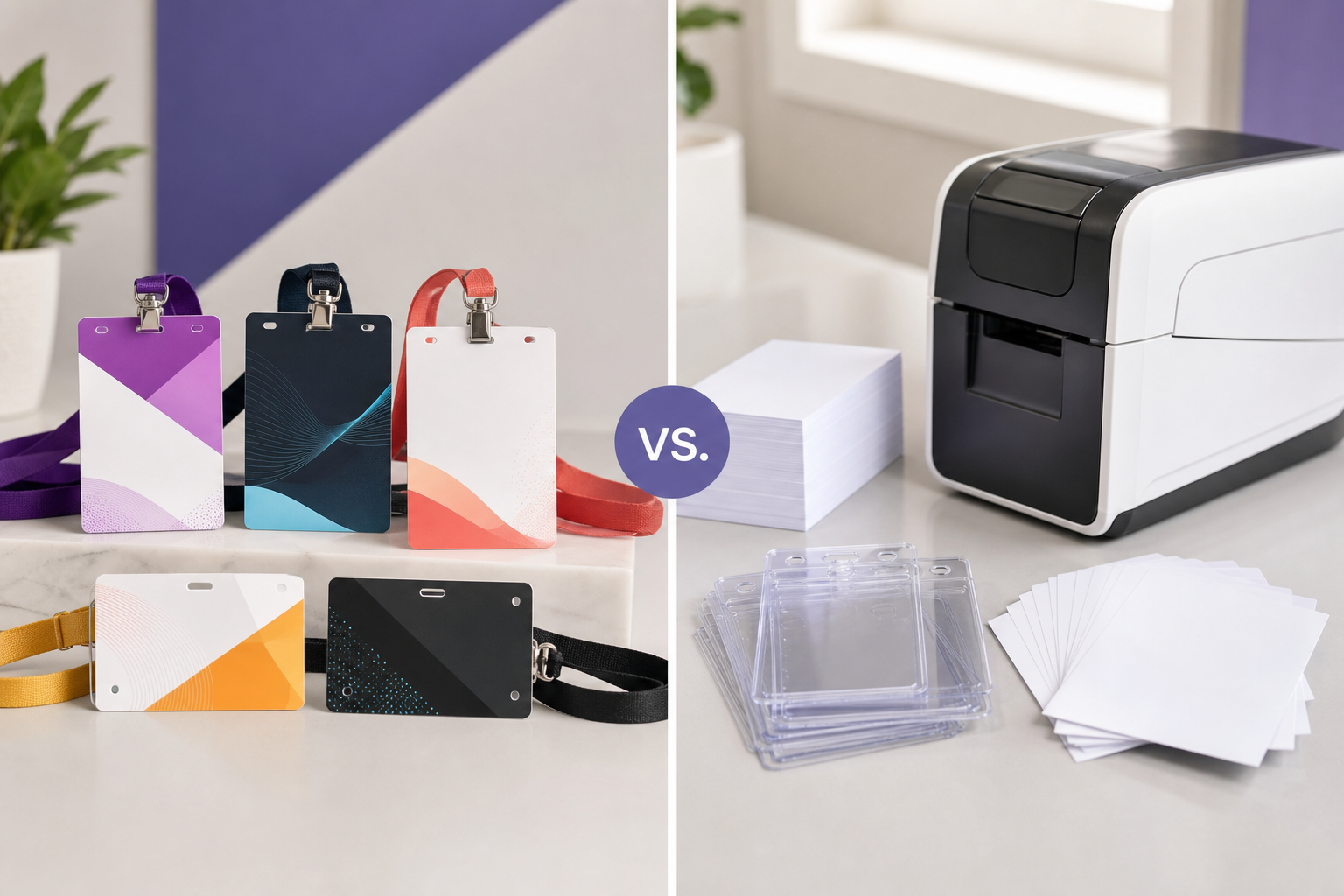
Define the four production models
| Model | What is printed in advance? | What changes later? |
|---|---|---|
| Fully pre-printed personalised badges | Branding and attendee data | Only exceptions and replacements |
| Pre-branded shells or stock | Logo, colours and fixed event information | Name, company, role and code |
| Blank inserts | Nothing | All content is printed from the badge file |
| On-demand onsite badges | Little or no attendee-specific content | Badge is produced as the attendee arrives |
Fully pre-printed personalised badges
In this model, each badge is complete before it reaches the venue. It works well when registration data is stable, the material needs professional finishing and the team can sort and ship the badges securely.
Advantages
- Consistent print and material quality
- Minimal attendee-specific printing at the venue
- Easy to include full-bleed branding and specialist finishing
Risks
- Late changes require separate replacements
- Cancellations can create waste
- Shipping or production delays affect the entire event
- Badges must be sorted accurately before check-in
Pre-branded shells
A shell contains fixed branding, while attendee data is printed later. This can combine premium visual quality with variable-data flexibility. It requires exact registration between the pre-printed material and the later printer output.
Test the shell through the intended printer. Coatings, thickness and pre-printed areas can affect toner or ink performance.
Blank badge inserts
Blank inserts keep the entire design editable until printing. They are useful when the team owns suitable printers, the attendee list changes frequently or several badge types share the same stock.
Advantages
- Fast design and data changes
- No dependency on pre-printed attendee data
- Easy to generate a new correction batch
- One stock can support several roles
Risks
- More in-house printing and handling
- Office-printer colour consistency may vary
- Cutting or separating inserts takes time
- Consumables and staff capacity need planning
On-demand onsite printing
On-demand printing produces badges at or near arrival. A full system may connect registration, check-in, validation and printers. It can reduce unused badges and handle walk-ins well, but it adds hardware, software, connectivity and staffing dependencies.
BadgeFlow can generate a corrected or newly added badge PDF, but it does not provide automatic check-in-triggered printing. See onsite badge printing for events for that distinction.
The hybrid model
A hybrid approach prints the stable majority in advance and reserves blank stock for exceptions. This is often the most resilient option for conferences:
- Print confirmed attendees before the event.
- Keep a reprint station for late registrations and corrections.
- Use the same design and physical format for both.
- Maintain a controlled reprint queue to avoid duplicates.
Compare cost correctly
Do not compare only the price of the card or sheet. Include:
- design and data-preparation time;
- printer purchase or rental;
- ink, toner, ribbons and maintenance;
- holders, lanyards and finishing;
- shipping and rush fees;
- sorting and packing labour;
- waste from cancellations and errors;
- event-day staff and contingency equipment.
The guides to printing badges on a budget and affordable event badging solutions provide broader comparisons.
Late registrations and cancellations
| Registration volatility | Most resilient approach |
|---|---|
| Low | Fully pre-printed or advance blank-insert production |
| Moderate | Advance main run plus a small reprint station |
| High | Pre-branded shell or onsite/hybrid workflow |
Waste and sustainability
Pre-printing too early can create unused personalised badges. Onsite production can reduce attendee-specific waste but may require specialist consumables and equipment. Reusable holders with replaceable paper inserts can reduce accessory waste across repeated events.
Measure actual waste after the event: uncollected badges, misprints, damaged stock, unused shells and discarded holders.
Branding quality
Professional pre-printing can deliver strong colour consistency and finishing. In-house printing offers flexibility but needs realistic expectations about edge-to-edge colour, material and printer capability. A clean, readable badge on reliable stock is more valuable than premium finishing that arrives late.
QR codes and barcodes
Variable codes usually need attendee-specific printing. If you use a pre-branded shell, reserve an uncluttered high-contrast zone for the code. Test the second-stage print alignment and scan through the final holder.
Shipping and deadline risk
A professionally printed run creates a delivery dependency. Build time for proof approval, production, shipping, sorting and replacements. For international or multi-venue events, consider producing regional batches or keeping a digital fallback file available.
Recommendations by event size
| Event size | Practical starting point |
|---|---|
| 100 | Blank inserts or adhesive badges printed in-house; simple reprints. |
| 500 | Advance PDF run with a small late-change batch. |
| 1,000 | Controlled advance batches or hybrid production with labelled sorting. |
| 5,000 | Professional or tightly managed bulk production, formal version control and robust onsite exception handling. |
For detailed spreadsheet production at scale, use bulk badge printing from Excel and the conference check-in checklist.
Decision checklist
- How stable is attendee data at the print deadline?
- Do you need premium material or finishing?
- Can the office printer handle the stock reliably?
- How many late registrations are expected?
- Who will sort and pack the badges?
- What happens if a shipment or printer fails?
- How will replacement badges be tracked?
- Can the same stock support advance and onsite output?
Scenario: 100-person leadership workshop
Blank inserts or adhesive badges are usually sufficient. The attendee list is small enough to print internally, and corrections can be handled without specialist equipment. Fully pre-printed personalised stock may add unnecessary lead time unless premium material is central to the event experience.
Scenario: 500-person annual meeting
An advance PDF run with reusable holders is practical when registration stabilises several days before the event. Print the main list in surname order and keep blank inserts for a late-registration batch. A pre-branded shell can be valuable if the organiser runs the same visual system every year.
Scenario: 1,000-person industry conference
Use formal batches for attendees, speakers, exhibitors and staff. A hybrid model provides resilience: most badges are produced and sorted in advance, while a dedicated reprint station handles changes. Track every batch and replacement by version and quantity.
Scenario: 5,000-person trade show
The production method becomes a major operations decision. A professional supplier, enterprise onsite system or carefully designed hybrid workflow may be justified. The organiser needs redundant hardware, data governance, shipping contingency, several registration lanes and a clear process for exhibitors and group orders.
Working with a badge supplier
Ask the supplier to define:
- accepted file and data formats;
- proof and approval deadlines;
- material, thickness and finish;
- variable-data and code-printing capability;
- cutting, punching, holders and lanyards;
- sorting and packaging options;
- late-change charges and turnaround;
- shipping method and replacement plan.
Request a physical proof containing realistic long names and code values. Confirm who is responsible for data accuracy after proof approval.
Quality control for either method
Whether stock is blank or pre-printed, inspect:
- finished dimensions and holder fit;
- name readability;
- role and access labels;
- colour consistency;
- QR or barcode scanning;
- front-to-back alignment;
- cutting, perforation or punch quality;
- sort order and batch counts.
Keep approved samples at the production and registration desks so staff can identify defects consistently.
Questions that reveal the best option
- What percentage of registrations typically arrive after the print deadline?
- How costly would a delivery delay be?
- Does the event already own suitable printers?
- Can staff finish and sort the badges accurately?
- Are premium materials part of sponsor or brand commitments?
- How many badges will need to be reprinted onsite?
- Can the same holder and stock be reused at future events?
Production deadline matrix
| Decision | Earlier deadline favours | Later deadline favours |
|---|---|---|
| Branding and finishing | Professional pre-printing | Blank or locally printed stock |
| Attendee accuracy | Stable registration lists | High-change or walk-in events |
| Shipping risk | Local supplier or early dispatch | Onsite or in-house production |
Build the deadline backwards from the event date. Include proof approval, production, shipping, sorting, packing and a replacement window. A supplier’s print time is only one part of the schedule.
Post-event review
Record how many badges were uncollected, reprinted, damaged and discarded. Compare those numbers with the labour and supplier costs. The data helps determine whether the next event should print later, use more blank stock or invest in a stronger onsite process.
Frequently asked questions
What is pre-printed badge stock?
It is badge material printed in advance with fixed event branding. Variable attendee details may be printed before the event or added later to the branded shell.
Are blank inserts cheaper than pre-printed badges?
They can be, especially when printed in-house, but total cost depends on labour, printer supplies, holders, waste, shipping and the value of staff time.
What is a hybrid badge-printing workflow?
A hybrid workflow pre-prints the fixed branding or main attendee batch and keeps blank stock available for late registrations, corrections and walk-ins.
Which option is best for 1,000 attendees?
A controlled advance run or hybrid approach is often practical. The decision depends on how many registrations are likely to change after the print deadline and whether onsite reprint equipment is available.
Can BadgeFlow trigger onsite printers from check-in?
No. BadgeFlow generates customised print-ready PDFs. Automatic print triggers, live check-in and printer-queue integrations require another system.